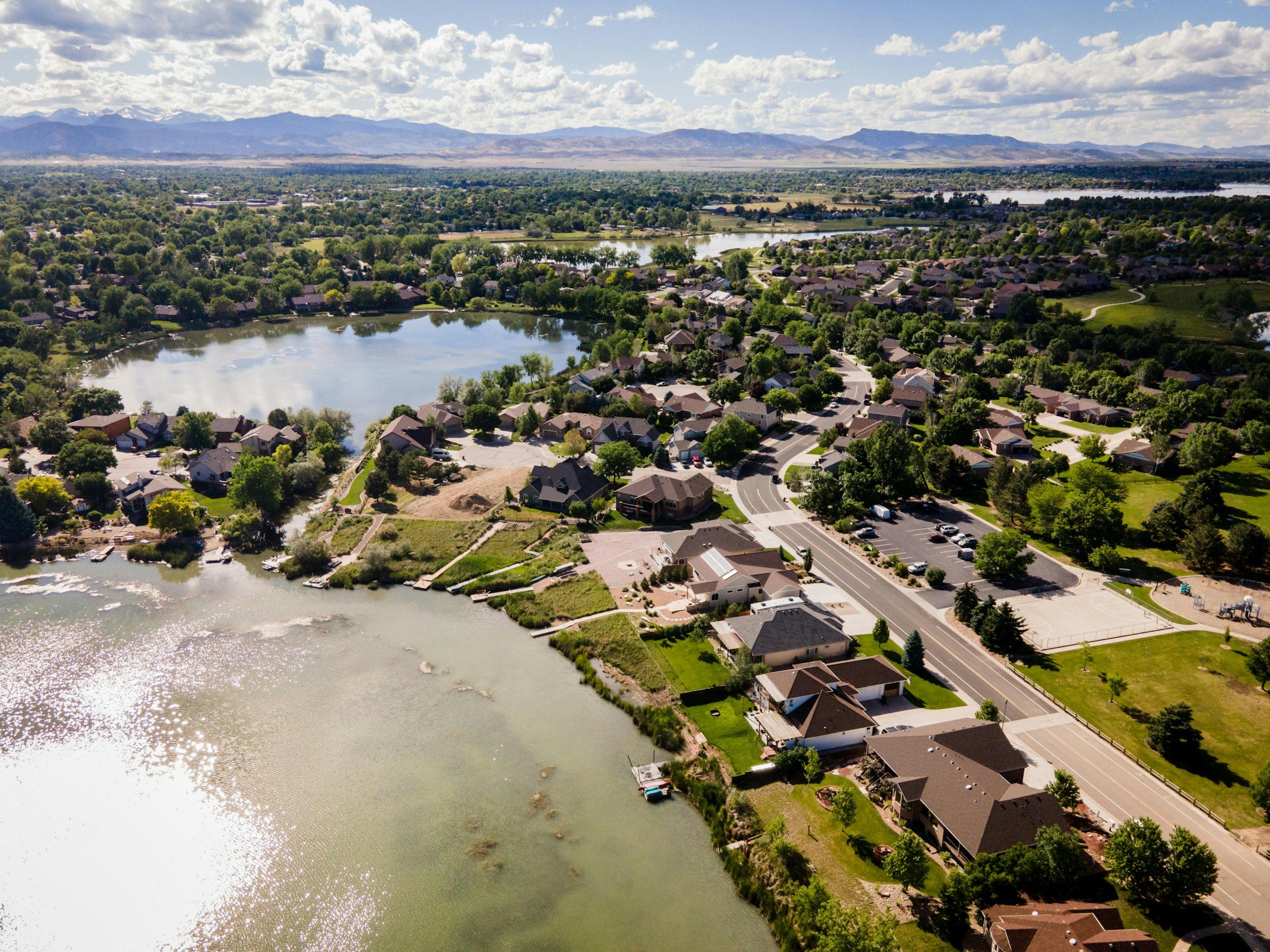
Swelling soil, collapsing soil and a Loveland basement
Swelling soil is the familiar Front Range problem: clay that takes on water and pushes a slab up. The survey's Loveland map ties it to the Pierre Shale, which, with the Niobrara, forms the hogbacks along the west edge of the area, tilted 18 to 25 degrees. Collapsing soil gets less attention. It shows up in dry, low-density windblown silts, which can compact when they get wet, so a floor drops instead of rising.
The finish details answer both. Partition walls hang from the floor framing with a gap above the slab, door frames are set so a small shift does not bind them, and nothing rigid ties the walls to the concrete. When a geotechnical report exists for the lot, we read it before design, because it tells us which soil we are working with. Our Colorado notes cover how that gap is sized.

If the Loveland site visit turns up this, then
The site visit decides more of the plan than any drawing. These are the findings that change the scope here.
A slab that has cracked or lifted
We find out whether the movement is old or ongoing. Active heave or settlement goes to a structural or geotechnical engineer first, and finishing waits for their answer.
A radon test at or above 4 pCi/L
Larimer County puts the area's average radon level at 7.8 pCi/L, against a national average of 1.3. A high result brings in a certified mitigation contractor before drywall, and the pipe gets its own chase in the plan.
A house on low ground near the Big Thompson
The September 2013 flood cut Loveland in two. For a house near the river, we check the flood map and the lot's drainage before anything else and ask what the basement saw that year.
A bedroom window too small for egress
Enlarging it means cutting the foundation and digging a new well outside, which is permitted structural work. That location then fixes where the bedroom goes.
How the City of Loveland permits a basement finish
Loveland's Building Division, part of Development Services, lists basement finish among the residential projects that need a building permit. The city has its own basement finish forms, and residential applications are submitted by email. A homeowner can do the work on their own primary residence with a homeowner affidavit. Structural, mechanical, electrical or plumbing work on a rental home requires a valid City of Loveland contractor's license.
Code editions are changing. City Council took up the 2024 International Code editions in January 2026, so we confirm which edition applies at the moment we submit and draw to it. Our common questions page covers ceiling height, legal bedrooms and when an engineer is needed.
Loveland houses, from the HP boom to Centerra
A 2010 survey prepared for the city describes a town that drew retirees through the 1950s and then grew fast after Hewlett-Packard opened a plant in 1960. Population went from 9,734 in 1960 to 16,220 in 1970 and 30,244 by 1980, as new subdivisions filled with modern homes. The 2020 census counted 76,378. Centerra, a 3,000-acre master-planned community at I-25 and U.S. 34, and the golf course homes of Mariana Butte on the west represent the later growth.
The rooms below work in a house from any of those decades. A guest suite gives visiting family a room with its own bath. A family lounge turns the bottom of the stair into the room everyone uses. And built-in storage and millwork keeps a mechanical room and seasonal gear out of sight.

Getting a Loveland basement on paper
Start with a radon test and the address. From there we can pull the flood map, ask about soils reports and schedule the site visit. Owners to the north can read about finished basements in Fort Collins, and to the south, Longmont. With both in hand, discuss your Loveland project.
Basement finishing questions from Loveland homeowners
Is a permit required for a Loveland basement finish?
Yes. The City of Loveland Building Division lists basement finish as a residential project that requires a building permit. You complete the city's basement finish forms and submit the application by email for plan review.
What are collapsing soils, and do they affect Loveland basements?
Collapsing soils are dry, low-density silty soils, often windblown, that can compact and settle when they get wet. The Colorado Geological Survey lists them, alongside swelling soils over the Pierre Shale, among the most prominent hazards in the Loveland area. We plan walls and finishes so the slab can move without cracking the room around it.
How high is radon in Loveland homes?
Larimer County reports an average level of 7.8 pCi/L for the area, well above the EPA action level of 4 pCi/L, and a highest recorded test of 1,147 pCi/L. Every house is different, so test yours before construction. Mitigation goes in while the walls are still open.
Can I finish my own basement in Loveland, or rent it out after?
A homeowner can do work on their own primary residence by filing a homeowner affidavit with the permit. For rental homes, the city requires a valid City of Loveland contractor's license for structural, mechanical, electrical and plumbing work.
More answers on permits, egress, radon and flooring are on our basement finishing questions page.